Episode 6 · Louis Braille, age 15 — Coupvray & Paris, France
The Kid Who Re-Invented Reading
He lost his sight at three. By fifteen he had invented an entirely new way for the world to read.
20 min listen · ages 8-10
The Kid Who Re-Invented Reading

Summary
At three years old, Louis Braille lost his sight after an accident in his father's workshop. By ten he was at a school for blind children in Paris, where books were enormous, rare and painfully slow to read. Louis was sure there had to be a better way — so he started experimenting with a secret code of raised dots, and by fifteen he had cracked it.
The Story
Louis Braille was three years old, playing in his father's leather workshop in the French village of Coupvray, when an awl slipped. He lost the sight in one eye, then an infection took the other. He grew up with no memory of ever seeing.
At ten he won a place at the Royal Institute for Blind Youth in Paris — a stagecoach ride and a whole world away from home. The Institute had books blind children could read: pages with letters embossed into thick paper. There were fourteen of them, for roughly a hundred pupils. Each one was huge, heavy and desperately slow to read letter by letter.
Then a soldier named Charles Barbier brought in his invention: "night writing," a grid of raised dots designed so soldiers could pass messages in the dark. It was closer to an answer — but a single word could take around a hundred dots, and it couldn't spell properly.
Louis was twelve. He kept the idea and threw away the rest. He worked at night, in bed, with knitting needles, forks, and the same kind of awl that had blinded him, punching dots into paper and reading them back with his fingertips.
By 1824 — age fifteen — he had it: a cell of six dots, small enough to sit under one fingertip, with enough combinations for every letter, number and punctuation mark. Crucially, a blind person could now write it as easily as read it.
The adults were not thrilled. A later director of the Institute had Braille's books burned and students' writing slates confiscated. The students kept using the code anyway, in secret. In 1844 a public demonstration convinced Paris, and in 1854 — two years after Louis died — his system was officially adopted.
Today it's read in nearly every language on earth, and Louis Braille is buried in the Panthéon. He was a kid with a hunch and a sharp piece of metal.
Timeline
1812
At age three, an awl accident in his father's workshop costs Louis his sight.
1819
Age ten, he wins a place at the Royal Institute for Blind Youth in Paris.
1821
Charles Barbier introduces "night writing" — raised dots, but far too many per word.
1824
Age fifteen, Louis completes his six-dot cell — readable and writable by touch.
1829
He publishes his system, crediting Barbier's original idea.
1840s
A new director burns the Braille books; students keep using the code in secret.
1844
A public demonstration in Paris wins the system real support.
1854
Two years after Louis's death, his system is officially adopted.
Key Takeaways
- ✓A good idea can come from someone else — what matters is what you do with it. Louis kept Barbier's dots and fixed everything else.
- ✓Being able to read wasn't enough for Louis. He wanted blind people to be able to write, too.
- ✓Grown-ups in charge can be wrong for years. The students knew the code worked long before the school admitted it.
Fun Facts
Photos & Field Notes

Sources
National Federation of the Blind — Louis Braille's 1829 book
The complete original publication, with French transcription and English translation.
Paula Kimbrough, "How Braille Began," Braille Monitor (NFB)
The bonfire aftermath, the knitting needles and forks, Guadet, and the 1844 demonstration.
American Foundation for the Blind — "The Life and Legacy of Louis Braille"
Multi-part online museum on the workshop accident, the invention of the code, and its recognition.
Library of Congress — National Library Service for the Blind and Print Disabled
Braille's biography, the problem of reading but not writing, and his reinterment at the Panthéon.
Musée Louis Braille, Coupvray
Braille's family home, now a museum; biographical background and his time at the Institute.
National Geographic — "How Louis Braille revolutionized a writing system" (2025)
The fullest narrative source: the hillside detail, his all-night work, and the flaws in Barbier's system.
History.com — "How Louis Braille Invented a Reading and Writing System for the Blind"
Barbier's "night writing," the 12-dot grid, and the ~100 dots needed per word.
TIME — "The Invention of Braille: A Wartime Story Behind an Alphabet"
Background on Barbier's system and his 1821 introduction of it at the Institute.
History Today — "Death of Louis Braille"
That Braille had no memory of sight, plus background on his 1829 book.
WIPO Magazine — "Bicentenary of Louis Braille: The world at our fingertips"
The account involving the awl and the 1824 completion date of the system.
Sight Scotland — "Who was Louis Braille?"
A straightforward account of Braille's childhood accident and loss of sight.
99% Invisible — "The Country of the Blind"
Background on Valentin Haüy and the treatment of blind people in 18th-century Paris.
Perkins School for the Blind — "First embossed book for the blind"
Haüy's embossed-print method and the development of early books for blind readers.
Duxbury Systems — A History of Braille
The Institute's fourteen books and ~100 pupils, the stagecoach, and the confiscated writing slates.
Hammill Institute Preservation Project — "Louis Braille (1809–1852)"
The 73 burned books, the official 1854 adoption, and Braille's decapoint system.
United Nations — World Braille Day background
Braille's continuing global importance and the observance of World Braille Day.
Transcript
HostCoupvray, France. 1812. A three-year-old boy is in his father's workshop, where the leather and the sharp tools are.
HostIn a moment he will lose his sight. He will never remember what seeing looked like.
HostNine years later he is at a school in Paris with fourteen books for a hundred children, and he is thinking: there has to be a better way.
LouisSix dots. Under one fingertip.
Full transcript continues in the show notes.
Related Episodes
EP 08 13 minMikaila Ulmer, age 4 — Austin, Texas
The Kid Who Put the Bee In Business
She got stung by a bee twice in one week. Instead of running away, she went into business with them.
EP 07 13 minEaston LaChappelle, age 14 — Mancos, Colorado
The Kid Who Gave The World a Hand
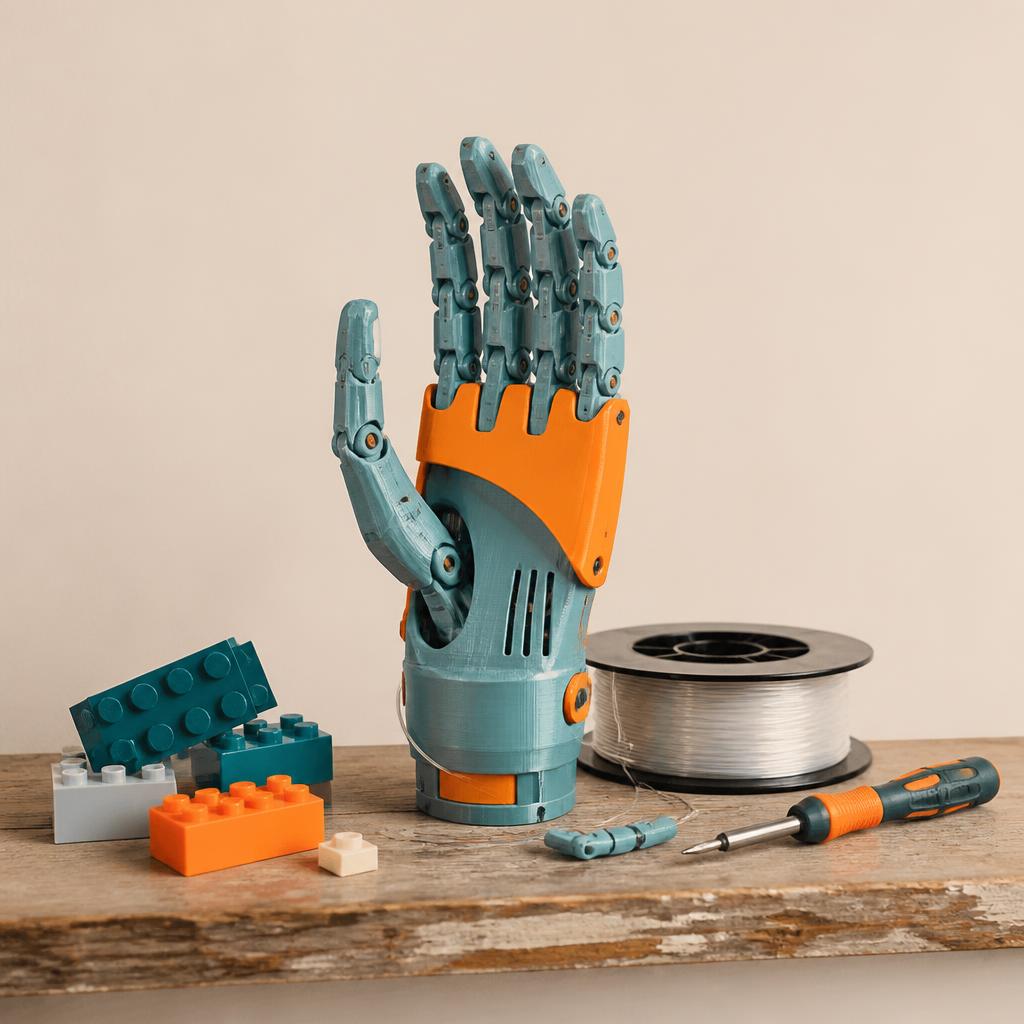
He built a robotic hand out of LEGO, fishing line and tubing. Then he met a girl whose prosthetic arm cost $80,000.
 EP 04 18 min
Richard Turere, age 13 — Kitengela, Kenya
The Kid Who Outsmarted Lions
He loved his family's cows — and hated what came looking for them after dark. Then he had an idea nobody saw coming.